
 The Indian Agricultural Research Institute (IARI) is the institute for advanced education in agriculture in India. It was established in 1905 as the Imperial Agricultural Research Institute.The campus was originally located in Pusa, Bihar and was shifted after the Bihar earthquake of 1934 to New Delhi to a place which is now called Pusa in New Delhi. The institute was recognized as a 'deemed university' in 1958 by an act of Parliament and since then it has awarded degrees M.Sc. and Ph.D. degrees. It is financed and administered by the Indian Council of Agricultural Research (ICAR). The IARI was responsible for the research leading to the "Green revolution" of the 1970s.
The Indian Agricultural Research Institute (IARI) is the country's premier national Institute for agricultural research, education and extension.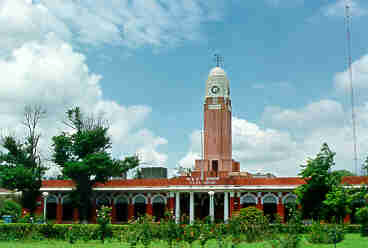 .It has served the cause of science and society with distinction through first rate research, generation of appropriate technologies and development of human resources. In fact, the Green Revolution was born in the fields of IARI and the graduates constitute the core of the quality human resource in India's agricultural research and education. The Institute has all along been adjusting and improving its policies, plans and programmes to effectively respond to the needs and opportunities of the nation. During the fifties, the advancement of scientific disciplines constituted the core programme and provided the base for its fast expansion in the 1960's and 1970's in all its three interactive areas, namely, research, education and extension. Besides basic research, applied and commodity research gained great importance resulting in the development of several popular high yielding varieties of almost all major crops and their associated management technologies, which brought about an unprecedented increase in the national food and agricultural production.
As per the research mandate of the Institute to conduct basic and strategic research with a view to understand the processes, in all their complexity, and to undertake need-based research, that lead to crop improvement and sustained agriculture productivity in harmony with environment to provide national leadership in Agricultural Research, Extension and Technology assessment and transfer by developing new concepts and approaches and serving as a national referral point for quality and standards, the Indian Agricultural Research Institute concentrated mainly its activities on:
School of Crop Improvements
School of Crop Protection
School of Basic Sciences
School of Resources Management
School of Social Sciences
Emphasize utilization of global plant genetic resources, including conservation of agriculturally important microbial, cyanobacterial and insect resources, to produce efficient, productive and stable genotypes of crops, especially hybrids, and improve bioenergenetics. Generate Knowledge related to the processes of production and productivity of agricultural crops leading to the development of research philosophies, concepts, methodologies, materials and technologies. Develop and use systems approach, crop modelling, bioindicators, nuclear tools, remote sensing and GIS to achieve greater understanding of the production systems, the resources, the environment and their sustainability and modify them to reduce the environmental and human health risks to make them more sustainable in the context of holistic ecological and socio-economic systems. .Pay greater attention to the problems of agriculture under unfavourable conditions and to orphan commodities. Foster excellence in agriculture related to basic and social sciences, strengthen synergism between traditional knowledge and modern science, and harness management sciences and communicaiton systems for improving overall efficiency. Develop capabilites in post-harvest technology, agro-processing, product development, value addition and utilization research on agricultural commodities, by-products, agricultural wastes and renewable energy resources. Concentrate on new and emerging cutting edge technologies such as molecular biology and biotechnology and develop inter-disciplinary centres of excellence with modern instrumentation and foster system research.
The research programmes of the Institute blend basic,strategic and applied research with an emphasis to develop practical solutions to complex problems in agriculture. Through multi-disciplinary research programmes, the Institute aims to tap the uncommon and unprecedented opportunities to gain a holistic understanding of crop biology.
The IARIs research agenda gives thrust on cereal research in view of the historic achievements that the Institute made during the last forty years in developing superior varieties of wheat, rice, pearl millet, maize, etc.
 The current emphasis, apart from stock improvement, is to develop superior varieties with exceptionally better grain qualities. The programme also aims at making the grain move in the value addition chain to promote the growth of agro-processing industries and to provide a competitive lead in the world grain trade. The research agenda was restructured to have a shared vision and to promote/complement each others talent to achieve the cherished goal. The major emphasis was to develop wheat technologies,consolidate the productivity gains, and enhance the grain quality, protein content, and chapati making quality with resistance to major diseases.