
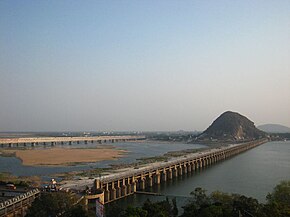
Krishna River flowing through the Western Ghats
Submitted by aurora on Tue, 2008-12-30 06:24
The River Krishna, meaning "dark" (feminine) in Sanskrit, also called the Krishnaveni is one of the longest rivers of India, which is about 1300 km in length.Krishna River originates in the Western Ghats at an altitude of about 1300 above sea level in Mahabaleshwar, about passes through Sangli and conjoins the sea in the Bay of Bengal at Hamasaledevi in Andra Pradesh. It flows through the states of maharashtra, Karnataka and Andra Pradesh. Most part of this river basin comprises undulating country except the western border which is formed by an unbroken line of ranges of the Western Ghats. The important soil types found in the basin are black soils, red soils, laterite and lateritic soils, alluvium, mixed soils, red and black soils and saline and alkaline soils. The delta of the river is one the most fertile regions in Bharat and was the home to ancient Satavahana and Ikshvaku sun dynasty, kings. Vijayawada is the largest city on the River Krishna.
The traditional source of the river is a spout from the mouth of a statue of a cow in the ancient temple of Mahadev in Mahabaleshwar. According to a legend, it is considered that the Krishna River is Lord Vishnu himself as a result of a curse on the trimurtis by Savitri. Also, its tributaries Venna and Koyana are said to be Shiva and Brahma themselves. An interesting thing to notice is that 4 other rivers, viz: Koyana, Venna, Savitri and Gayatri, come out from the bull`s mouth apart from Krishna and they all travel some distance before merging into Krishna. The Krishna River sometimes gets disastrous in the monsoon seasons. Flowing fast and furiously, the Krishna River causes a high degree of erosion between June and August, often reaching depths of over 75 feet. It`s most important tributary is the Tungabhadra River, which is itself formed by the Tunga River and Bhadra River that originate in the Western Ghats. Other tributaries include the Koyna, Bhima, Kundali, Malaprabha, Ghataprabha, Yerla, Warna, Dindi, Musi and the Dudhganga River.
The rivers Koyna River, Vasna, Panchganga, Dudhganga, Ghataprabha River, Malaprabha River and Tungabhadra River join Krishna from the right bank; while the Yerla River, Musi River, Maneru and Bhima rivers join the Krishna from the left bank. (Image: Sangameshwar temple at river Krishna)There are many dams have been constructed on the river.Temples like Dattadeva temple, which is very dear to the people of Maharashtra is localed on the banks of Krishna at Narasoba Waadi. Also, Sangameshwar Shiva Temple at Haripur and Ramling Temple are located on the banks of river Krishna near Sangli.
Popular pilgrim spots like Audumber and Narsobawadi are located on the banks of river Krishna near Sangli in Maharashtra state. More pilgrim spots can be explored, especially that of Srisailam, one of the twelve jyotirlingas which also has a shrine for one of the shaktipeethasis on the river. Three tributaries meet Krishna River near Sangli. Warana River meets Krishna River near Sangli at Haripur. This spot is also known as Sangameshwar (Image of Snagameshwar). Panchaganga River meets Krishna River at Narsobawadi near Sangli. These places are considered among the most sacred in Hindu mythology. It is said that Lord Dattatraya spent some of his days at Audumber on the banks of river Krishna.
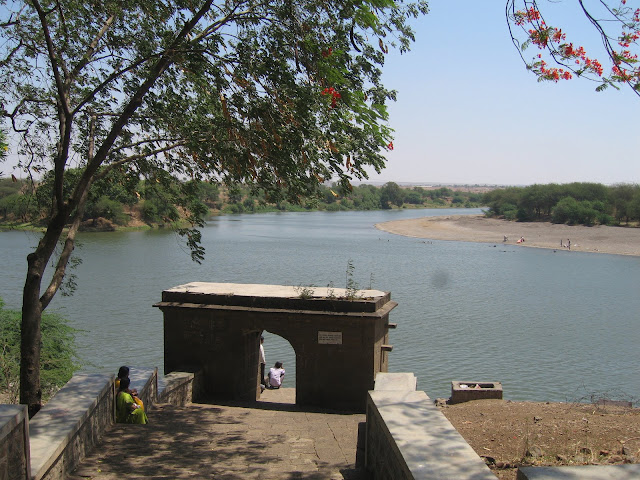
Ecologically, this is one of the disastrous rivers in the world, in that it causes heavy soil erosion during the monsoon season. It flows fast and furious, often reaching depths of over 75 feet (23 m). Ironically, there is a saying in Marathi "sunt vaahate Krishnamaai" which means "quiet flows Krishna". This term is also used to describe how a person should be, as quiet as Krishna. But, in reality, Krishna causes a high degree of erosion between June and August. During this time, Krishna takes fertile soil from Maharashtra, Karnataka and western Andhra Pradesh towards the delta region.
World Blood Donor Day

Although all reports indicate that the city is running at possibly the lowest levels of stocks for certain blood components, it is not that Sankalp is just complaining about it. Over the 2 month period from June 2010 to July 2010, Sankalp organised multiple blood donation drives with more than 1100 units of blood being collected. A million thanks to all the organisers and donors for standing up to the challenge. Here is a brief note on all the various camps held with different organisations.
With most of the Sankalp volunteers on vacation due to semester end holidays, only a handful of volunteers are involved in various Sankalp activities. Here is a snapshot of what happened in Sankalp over the last few days
The dengue infections have reached their peak in Bangalore. We have scores of patients around the city receiving treatment for the same. A direct impact of this is the increase in workload of the Sankalp Emergency Team.
Normally after a good blood doonation drive we try to sit back for a while believing that the units collected in the drive will be available to the patients. However, this season it is different. On Saturday 17th July, we had more than an hour long session when the phone hardly was put away. We had more than 6 blood requests - all for platelets - and all of them for multiple units of platelets. The city is seeing the worst crunch for platelets. The poor staff at the call centre is reporting nil stocks for platelets for most part of the day and simply forwarding the requests to be handled as emergency. And for the emergency team, the challange of ensuring timely supply of platelets is becoming a bigger challange with each passing day.
The World Blood Donor Day is celebrated on a world-wide scale on 14th June. This time Sankalp has taken the initiative to organize a Blood Donor Week .
The week highlights are inauguration of World Blood Donor Week, Donor Felicitation program organized in M. S. Ramaiah Memorial Hospital and Blood Grouping and Haemoglobin testing in all the Institutes in Ramaiah Campus.

Since it's inception, Sankalp has called itself a blood donation organisation. Those are big words for a bunch of engineers, because blood is a vast area in the medical field. understanding blood becomes highly critical for all volunteers and work in a more meaningful manner. there have been tremendous advancements in science and this has led to various new things.
One fine evening, Few of the volunteers of Sankalp emergency wing received a call. A patient in Gulbarga urgently needed AB- blood. Gulbarga is one of the remotest places in Karnataka with very little blood awareness, and finding a donor there was a tough challenge.
The Year 2009-10 was an eventful year for Sankalp India Foundation. The group of 30 individuals who call themselves Sankalp volunteers were kept very busy with the back to back activities that took place in the last year. We are happy to bring to you the yearbook of 2009-10.
The month of May was a busy one for the Sankalp volunteers. Most efforts went into getting things moving for the anniversary programme. Nevertheless, some things are always important and they have to move on. The clock ticks on, and so do the volunteers of Sankalp in their respective teams. Here is an update of what happened in the month that went by
Sankalp India Foundation is happy to announce it's much awaited "Disaster Relief Partner Program". First of it's kind in the country, this Program lays the roadmap for better disaster response planning.
On the 22nd of May this year, Sankalp India Foundation celebrated being 7 years old. To mark this milestone, a small event was organized at MSRIT. Well wishers, parents of volunteers, members from the blood banking community, friends, and people from organizations with whom we work were all part of the event.
CTC Disha
April was a busy month for the Disha team. The team started work to ensure that the online update mechanism that has been setup to ensure better inputs for other Sankalp team comes on track. The initial few sheets have been added and more is being done to provide regular accurate inputs.

The Brand New Sankalp T-Shirts are on their way. It costs Rs 250, gray in color and is available in Small (S), Medium (M), Large (L), Xtra Large (XL) sizes.
One of the unique characteristics of Sankalp is the fact that all volunteers are not from the medical community. Stumped? Almost all of the 30 volunteers who work on various aspects in the filed of blood are engineers!.
The emergency wing of Sankalp are always on their toes attending to emergency blood requests. Requests for rare blood groups, from places not heard of and more. All these have become a part of their daily routine. Helpling people find the right unit of blood at the right time has been the overall objective, and the team does it efficiently well.
One more blood request was catered! One more life was saved! The volunteers of Sankalp emergency wing had one more story to tell!
It was only yesterday, that a lady from Davanagere needed blood of the Bombay negative group. Nature acts in strange ways! Remove the Rh and H antigens from O positive blood- the most common group, and you'll have Bombay negative group blood- the rarest blood group possible! The possibility of finding this group donor is one out of twenty five thousand, biologically! Practically, most don't know their blood groups- so finding a donor was no less than locating a pin in a football ground! The volunteers took it up as a fresh new challenge- something they had never faced before!
The early history of British expansion in India was characterised by the co-existence of two approaches towards the existing princely states. The first was a policy of annexation, where the British sought to forcibly absorb the Indian princely states into the provinces which constituted their Empire in India. The second was a policy of indirect rule, where the British assumed suzerainty and paramountcy over princely states, but conceded some degree of sovereignty to them. ..
India, a nation that has undergone complete transformation after it got independence from the British Rule. But somehow the influence from the West never ceased to affect our culture and the growth of the Nation. The three major transforms taken from the entire lot is the way Mobiles, Cars and Malls have brought to the India nationality.
The story before: The positive role that dairying could play in providing income and employment opportunity was clear to policy-makers long time back and a set of measures were put in place to develop and protect the dairy industry. Immediately after India gained independence, the Milk Control Board was set up which controlled the supply and distribution chains.
India and space laws: A millennium perspective
THE LAUNCH of Sputnik 1 by the former Soviet Union in 1957, followed by a similar feat by the U. S., within a few months, heralded the birth of the space age. The development and application of space technology has since made a tremendous global impact in diversified fields including social, economic, cultural and scientific.
India is a country with a diversity of languages. Out of more than one thousand mother tongues, only eighteen languages are included in the eighth schedule of the Indian Constitution. Development of a particular state or region, to a very great extent, depends on the development of its regional language. This was an important reason given at the time of the formation of linguistic states, though many criticized such a linguistic “division” or “re-organization”.
 Past two decades have seen an unprecedented rise in the number of farmer suicides in our country. Across the nation, lacks of farmers have taken their lives in these years. Though this process is on for almost 2 decades, but it is only now that the nation is getting to know the seriousness and the extent of it. We are going through the worst ever farm crisis in the history of our nation.
3rd December 1984 Shortly after midnight poison gas leaked from a factory in Bhopal, India, owned by the Union Carbide Corporation. There was no warning, none of the plant's safety systems were working. In the city people were sleeping. They woke in darkness to the sound of screams with the gases burning their eyes, noses and mouths. They began retching and coughing up froth streaked with blood. Whole neighbourhoods fled in panic, some were trampled, others convulsed and fell dead. People lost control of their bowels and bladders as they ran. Within hours thousands of dead bodies lay in the streets.

It is hard to imagine today that there existed a time in independent India when the then Prime Minister of the country, Sw. Lal Bahadur Shastriji had to appeal to the nation to skip one meal a day. Our nation saw one of the darkest era when we faced acute shortage of food in the 60s. Ships from America brought in bad quality grain as charity to feel us and the Nation battled with the problems of rising prices and hunger.
 The Emergency in India denotes the 21-month period between June 25, 1975 and March 21, 1977 when President Fakhruddin Ali Ahmed, upon advice by Prime Minister Indira Gandhi, declared a State of Emergency in India under Article 352 of the Constitution of India, effectively bestowing on her the power to rule by decree, suspending elections and civil liberties. It is one of the most controversial periods in the history of independent India. During the Emergency, many opposition leaders were jailed, freedom of press was suspended and powers of the judiciary were curtailed
The Ancient Legend
In India there is an ancient legend about a girl, Amrita Devi, who died trying to protect the trees that surrounded her village. The story recounts a time when the local Maharajah's tree cutters arrived to cut the villager's trees for wood for his new fortress. Amrita, with others, jumped in front of the trees and hugged them. In some versions of the tale their dramatic efforts prevented the forest's destruction; in others Amrita dies in her valiant attempt.
The All India Muslim League (AIML) was formed in Dhaka in 1906 by Muslims who were suspicious of the Hindu-majority Indian National Congress. They complained that Muslim members did not have the same rights as Hindu members. A number of different scenarios were proposed at various times. Among the first to make the demand for a separate state was the writer/philosopher Allama Iqbal, who, in his presidential address to the 1930 convention of the Muslim League said that a separate nation for Muslims was essential in an otherwise Hindu-dominated subcontinent.
|