
For a parent whose child needs regular blood transfusions, learning that a transplant could offer a cure brings hope. But another question soon follows: can we reach that care, and can we afford it? A collaborative study involving Sankalp, Cure2Children Foundation and partner centres explores how more families could have that opportunity.
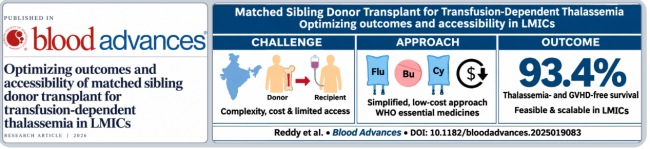
Published in Blood Advances, a journal of the American Society of Hematology, the study followed 176 children under 14 with transfusion-dependent thalassemia, each receiving bone marrow from a fully matched sibling. The approach used widely available medicines from the WHO Essential Medicines List, supported by trained teams, careful monitoring and expert guidance.
At a median follow-up of 11.3 months, the study reported approximately 96% overall survival and 93.4% thalassemia-free survival, encouraging results for children whose lives had depended on repeated transfusions. Early findings from newly established centres were also promising, suggesting potential to extend access. Longer follow-up remains essential to understand lasting outcomes.
Reported transplant costs, including follow-up, ranged from US$8,000–10,000. For families facing financial barriers, finding ways to make quality care more affordable matters deeply. We share these findings with gratitude to every participating family, team and the hope that fewer parents will find the possibility of cure beyond their means.